
A thoughtful gift does not need a big number attached to it. It needs evidence that you were paying attention. The gifts people keep are almost always the ones that prove someone noticed something about them and bothered to act on it.
What makes a gift feel considered?
A named detail the recipient recognizes as theirs.
Not a category, a detail. "She likes gardening" is a category, and it produces the same gift every year. "She has been trying to keep one difficult plant alive since March and talks about it constantly" is a detail, and it produces a gift she will actually remember receiving.
Details are collected, not invented on the day. The people who seem effortlessly good at this are usually just writing things down. A note on your phone, added to whenever someone mentions wanting something or complains about something, will outperform any amount of last-week deliberation.
Why does personalization work better than expense?
Because attention cannot be bought at the last minute, and everybody knows it.
Money is a general-purpose signal. It says a gift mattered, but it says nothing about who the gift is for. A specific reference says the opposite: it demonstrates time spent thinking about one particular person, which is the scarcer resource and the one that cannot be delegated.
This is also why personalization fails when it is only a name printed on something generic. A name is not a detail; it is a label. The work is in the observation, and the object is just where the observation gets recorded.
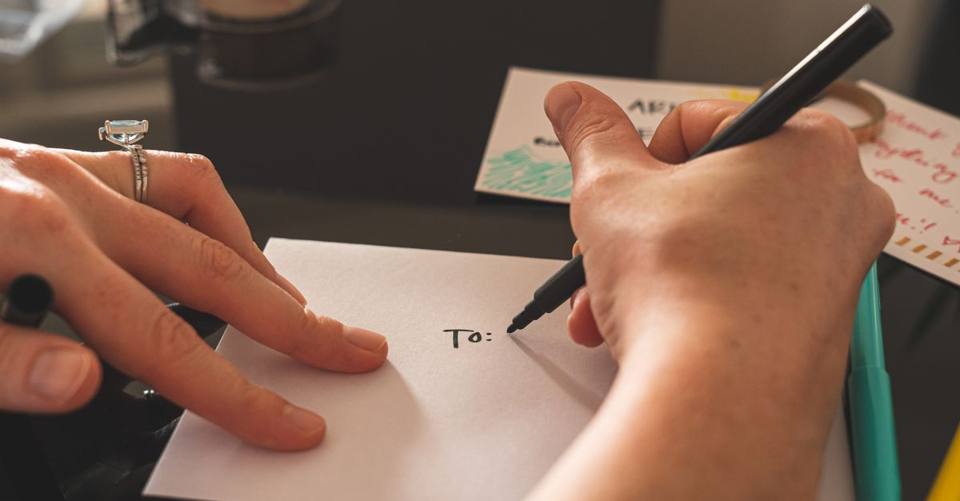
Turn a Detail into Original Words
Answer three questions and you will have a message.
The three-question method
- What happened? Describe one moment plainly, with a place and a time.
- Why does it matter? Say what it revealed about them, or about you.
- What do you want them to remember? One sentence, no hedging.
Those three answers, trimmed and broken into lines, are a poem. Most people can produce them in about ten minutes, which is considerably less time than is usually spent browsing for a gift that will not be remembered.
What to cut
Cut anything that would survive being handed to a different person. Cut adjectives doing the work that a detail should be doing. Cut the phrase you have heard on a card. If a line sounds like something you have read before, that is because it is, and it will read that way to them too.
If you use assistance to draft it
If you are unsure where to start, the editor can draft a poem from a few details you provide, and every line stays editable before you order. Then revise every line: replace general praise with your language, verify every fact, and delete anything that overstates the relationship.
Avoid quotations unless the text is original to you, in the public domain, or licensed for your use. A line being famous does not make it available, and attribution by itself does not grant permission.
When personalization goes wrong
Three failure modes are worth knowing about. An inside joke that needs explaining stops being funny on a wall. A detail that is slightly wrong is worse than no detail at all. And a private reference displayed in a shared room turns a gift into an obligation to explain it to visitors.
Keep the Next Step Simple
In the editor you can write or paste your own poem, adjust the text and fonts, and choose a background or photo. Review the full design before checkout and correct anything that does not match the person or the occasion.
Is a personalized gift appropriate for someone I do not know well?
Yes, if you scale the intimacy to the relationship. For a colleague or a newer friend, a specific but public detail works well: something they are known for, a shared project, a running joke the whole group is in on. Save the private observations for people who would expect you to have them.
What if I cannot think of a single detail?
Then ask someone who can. A sibling, a close friend, or a partner will usually produce three usable details in a two-minute conversation, and asking is not cheating. The gift still required you to notice that you needed better information and go find it.
Does personalization work for group gifts?
It works well, and it solves a real problem: group gifts tend to default to the blandest option everyone can agree on. Collecting one specific line or memory from each contributor gives you lines nobody could have produced alone, and it makes the gift genuinely from the group rather than from whoever organized it.
How do I avoid it feeling like a greeting card?
Say one thing instead of four, and choose the thing you would be slightly hesitant to say out loud. Cards are bland because they are written to fit everyone. Your version only has to fit one person, so use that freedom rather than writing toward the middle.
Is it worth doing for occasions that come around every year?
Especially then. Annual occasions are where generic gifts accumulate, so a specific one stands out more, not less. Writing about what changed since last year also gives you a naturally fresh subject every time, which solves the repetition problem before it starts.
For the mechanics of turning a memory into lines, see what makes a personal poem land. If the date is close, the short-notice guide covers how to narrow the idea quickly. The public gallery offers ready-made plaque designs you can open in the editor and personalize.