
Mother's Day in the United States grew out of several reform and remembrance efforts rather than one moment. The Library of Congress credits Anna Jarvis with the campaign that led to national recognition after her own mother's death in 1905.
When did the U.S. observance become official?
In 1914, after roughly a decade of campaigning.
Anna Jarvis organized a memorial observance in 1908. Congress acted in May 1914, and President Woodrow Wilson issued a proclamation on May 9, 1914, calling for the second Sunday in May to be observed as Mother's Day in the United States.
The gap between 1905 and 1914 is the part usually skipped. This was not a spontaneous outbreak of national sentiment; it was a sustained letter-writing campaign by someone who wanted a specific thing recognized and kept at it for years.
What came before Anna Jarvis?
Organizing work with broader aims than a single family day.
Earlier advocates, including Ann Reeves Jarvis and Julia Ward Howe, connected mothers' organizing with public health, reconciliation, or peace. Those efforts were civic in character. They treated mothers as a constituency with a claim on how the world was run.
Anna Jarvis narrowed the later observance to honoring one's own mother, one relationship at a time. Both versions of the holiday still exist in the way people mark it, which is part of why the day can feel by turns intimate and oddly public.

A Holiday with Competing Meanings
The founder of the modern observance ended up fighting the thing she started.
The commercialization conflict
The Smithsonian American Women's History Museum documents that Jarvis later objected strongly to the commercialization of the day she had campaigned for.
That objection is not a footnote. It is the clearest signal in the whole history of what the observance was supposed to be: a personal act of remembrance, not an occasion to be supplied. You can decide for yourself how far to take that, but it does suggest that the effort you put into what you say matters more than what you attach it to.
Why a written message fits this particular holiday
The original observance was a memorial. Its founder wanted attention paid to one specific woman, by the people who actually knew her. A message written in your own words is closer to that intent than almost anything else you could do, and it is the part no one else can supply for you.
When the day is complicated
Not every reader has a straightforward relationship to mark, and pretending otherwise is how greeting-card language earns its reputation.
If the relationship is strained, write what is true and narrow: one thing you learned, one habit you kept, one moment you would not undo. If your mother has died, the observance was founded as a memorial, so writing to her rather than about her is entirely within the tradition. If you are honoring a grandmother, stepmother, aunt, or a friend who did the work, name the actual relationship instead of borrowing a word that does not fit.
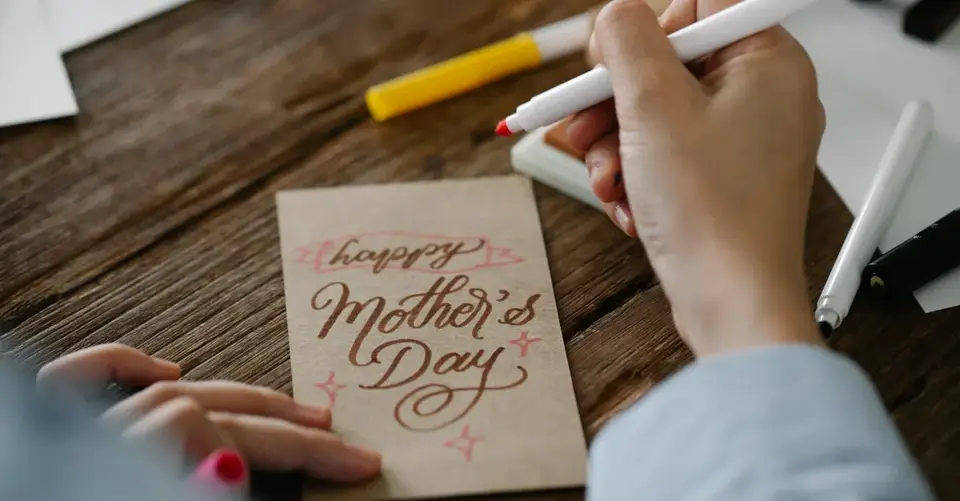
Keep the Message Specific
A personal note can name one lesson, one habit, or one memory you value. The aim is not to summarise a person or to make every family fit the same story. Write for the person you are honoring and the relationship you actually have.
Specificity is what separates a message from a card. Compare "thank you for everything" with "thank you for never once making me feel stupid for asking." Only one of those could have been written by you, about her.
If you are stuck, finish one of these privately first and see what comes out:
- The thing she says that I catch myself saying now is...
- She was right about...
- The version of her I want to remember is the one who...
Who actually started Mother's Day?
Anna Jarvis led the campaign that produced the U.S. observance, following her mother's death in 1905 and a memorial observance she organized in 1908. Earlier advocates, including Ann Reeves Jarvis and Julia Ward Howe, had connected mothers' organizing with health, reconciliation, or peace, so the holiday has more than one ancestor.
Why is it on the second Sunday in May?
Because that is the date named in the proclamation President Woodrow Wilson issued on May 9, 1914, after Congress acted earlier that month. The date is a U.S. designation rather than a universal one, so it is worth checking the local observance if you are writing to someone in another country.
What do I write for a mother who has died?
Write to her, not about her, and keep it to one thing. The observance began as a memorial, so a remembrance is entirely in keeping with the day. One habit, one saying, one afternoon you remember clearly will carry more than a summary of her life, and it will be easier to reread in later years.
What if my relationship with my mother is difficult?
Write only what is true, and make it narrow. A single honest sentence about one thing you learned or one thing you are grateful for is a complete message. You are not obliged to produce warmth you do not feel, and a message that overstates the relationship tends to read as hollow to both of you.
Is it better to write my own words or use a quotation?
Your own words, nearly always. If you do want to include a quotation, use text that is original to you, in the public domain, or licensed for your use, since attribution alone does not grant permission. A borrowed line works best as a frame around something you wrote yourself.
If you want a starting point for the wording, the Mother's Day ideas page and the gifts for mom page both show how a short message sits inside a finished design. For collecting memories from several relatives before you write, the guide to gathering family memories has a workable process.
If you are unsure where to start, the editor can draft a poem from a few details you provide, and every line stays editable before you order.