
The honest answer is that Valentine's Day has no single, traceable beginning. The Library of Congress describes the holiday's origins as murky. Several early Christian martyrs carried the name Valentine, a Roman festival sat nearby on the calendar, and the romantic meaning arrived centuries later.
What is actually documented about the early history?
Less than most articles suggest, and that is the interesting part.
What survives is a scattering of facts rather than a story. There were martyrs named Valentine. There was a February observance. There was, much later, a well-established association between the middle of February and romantic love. The connective tissue between those points is where the confident retellings quietly start inventing.
This matters if you are writing something for someone you love. A holiday assembled from fragments over many centuries is a better argument for making your own meaning than a holiday handed down intact from antiquity would be.
Where does the Lupercalia story come from?
From proximity on the calendar, not from a documented handover.
Lupercalia was a Roman festival held in the middle of February. Because it sat near the date that later carried Valentine's name, generations of writers have described one celebration as directly replacing the other, often adding a matchmaking lottery that pairs young people by drawn names.
Calendar proximity is not evidence of succession. The careful version is that Lupercalia is a possible influence on a February observance, and that the matchmaking detail is a later embellishment rather than a recorded Roman custom. If a claim about the ancient world only ever appears in holiday listicles, that absence is itself informative.
How Romance and Cards Entered the Tradition
The romantic meaning becomes visible in medieval Europe, and the paper trail improves from there.
The medieval turn
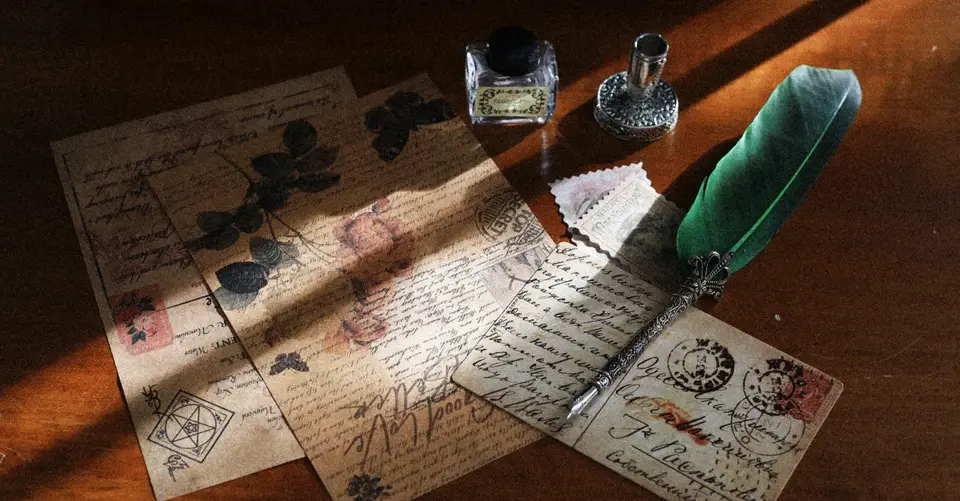
The Library of Congress connects the date with a medieval belief that birds chose their mates in mid-February, and notes that lovers marked the day by exchanging verse and prose. That is a modest claim, and it is also the first point where the holiday starts to resemble the one we keep.
Notice what the earliest romantic observance consisted of: writing. Not spending, not staging, not sourcing an object, but words set down for one specific person and handed over. Everything since has been a variation on that.
From handwriting to printing
Handmade valentines appear by the sixteenth century. Card production expanded in later centuries, which is when the holiday acquired the industrial scale it has now.
That documented arc, from exchanged verse to handmade tokens to printed cards, is a much firmer bridge to your February the fourteenth than any ancient matchmaking legend. It also explains the modern complaint about the holiday feeling commercial. The complaint is not that the tradition changed; it is that the writing part became optional somewhere along the way.
Why the murky version is more useful
A holiday with a single tidy origin invites you to perform it correctly. A holiday assembled over centuries invites you to add to it. The second framing is both more accurate and considerably less stressful.
Make the Tradition Personal
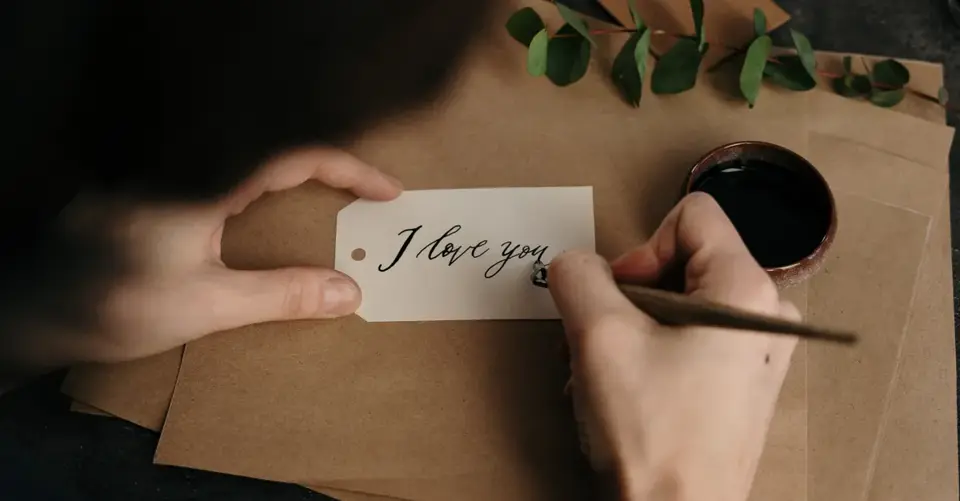
You do not need a legendary origin story to make the day mean something. The oldest documented version of this holiday was two people and some written lines, which is still available to you.
Start with a shared memory, a quality you admire, or a hope for the year ahead. Then push each one until it could only apply to one person. "You are kind" belongs to everyone. "You apologize to furniture you bump into" belongs to exactly one person, and it will still be funny in a decade.
Three prompts that tend to produce something worth keeping:
- Describe the most ordinary Tuesday you have ever enjoyed together, in detail.
- Name a small thing they do that you noticed early and never mentioned.
- Finish the sentence "I did not expect to love that you..." and keep going.
Use original words, public-domain text, or text you have permission to reproduce, then edit until it sounds like you rather than like a card.
Is Valentine's Day really based on a Roman festival?
Not provably. A Roman festival occupied a nearby date, and several early martyrs carried the name Valentine, but the direct-replacement story and the matchmaking lottery are later embellishments rather than documented history. Treating the origins as genuinely uncertain is both more accurate and more honest than repeating a tidy timeline.
When did the day become about romance?
The romantic association becomes clear in medieval Europe, where the date was linked with a belief about birds choosing mates and with lovers exchanging verse and prose. That is several centuries after the martyrs the day is named for, which is why the early history and the romantic history are best told as separate threads.
What should I write if I am not a writer?
Write one specific true thing and stop. Length is not the measure. A single concrete observation, plainly said, reads as more considered than four rhyming stanzas of general praise, because only one of those could have been written about this particular person.
Can I use a famous love poem instead?
Only if the text is original to you, in the public domain, or licensed for your use. Attribution by itself does not grant permission, and a poem being widely quoted online does not make it free to reproduce. Public-domain verse is a genuine option, but pairing a borrowed line with one of your own is usually the better read.
When you are ready to see how the words sit against a photo or background, you can start from the Valentine's Day ideas page or open something from the gallery and make it yours. For help getting the first lines down, this walkthrough on writing poetry with no experience covers the blank-page problem in detail.
In the PlakYourPoem editor you can write or paste your own poem, adjust the text and fonts, and choose a background or photo before ordering.